
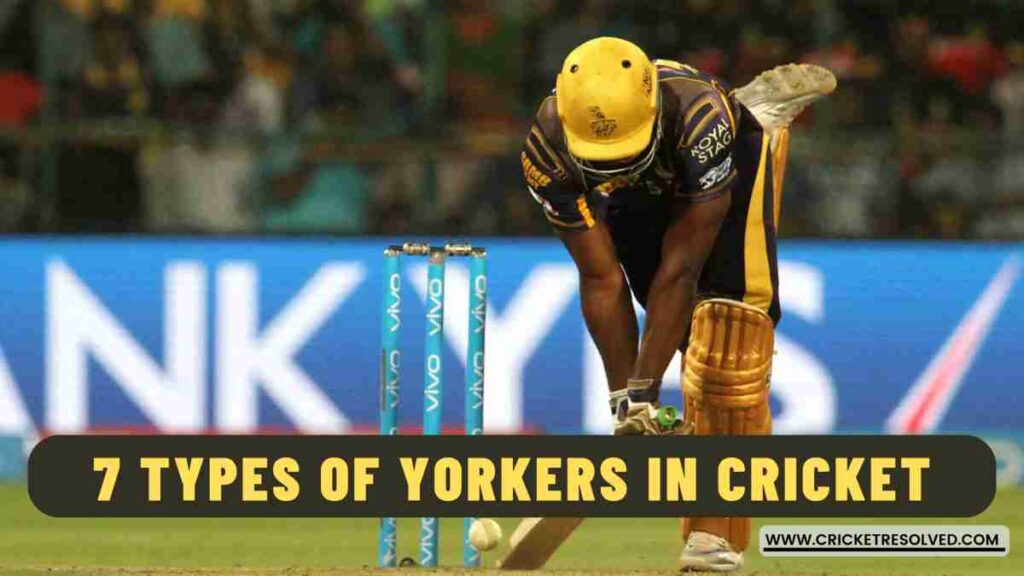
There’s no better way to keep a batter quiet than a yorker. It’s a no-nonsense delivery bowled right at the base of the stumps.
And if the batter is a little late in timing the shot, then an injury is unavoidable. It can be that devastating.
So, a yorker is no less than a weapon for bowlers. And they have come up with several variations of this lethal delivery.
What? Variations in yorkers? Yes, and they can be destructive as well.
Let’s see the different types of yorkers one by one.
Conventional Yorker
This one is a pretty common yorker. You’ll often notice bowlers bowling a conventional yorker, more so in the death overs.
The yorker has all the pace and drops right at the bottom of the stumps. If batters mistime it, then it’s all over. Either the ball will crash on the stumps or the batters will find themselves trapped LBW.
Lasith Malinga bowled the conventional yorker to its full effect. He could nail those even while asleep!
Slower Yorker
It’s a slightly toned-down version of the conventional yorker. Toned down in terms of pace.
But a lesser pace doesn’t mean no trouble for the batter. Rather, the slow pace might prompt them to commit to the shot early. And this might open up an opportunity for a bowled or LBW dismissal.
Bowlers often bowl a slow yorker with a back-of-the-hand delivery. The back-of-the-hand variation helps them take the pace off.
Dwayne Bravo used to bowl slow yorkers in the slog overs to put the brake on run-scoring.
Inswinging Yorker
Many batters struggle to navigate normal swing deliveries. And the hardship just multiplies against an inswinging yorker.
Bowlers get enough help to swing the new ball. So they can try to restrict batters with a deadly inswinging yorker.
The ball shapes in late in the air, right before it pitches in front of the stumps. Due to the late movement, batters don’t get much time to react.
And many have experienced it against Mitchell Starc. The Australian quick has mastered the inswinging yorkers to the core. Remember Ben Stokes’ dismissal off his inswinging yorker?
Outswinging Yorker
This is the exact opposite of the inswinging yorker. But you won’t see bowlers delivering outswinging yorkers a lot. The ball shapes away in the air before it crashes onto the wickets.
Also Read | How to Swing a Cricket Ball?
Reverse Swing Yorker
If the new ball swinging yorkers didn’t trouble you enough, then there’s a reverse swing yorker waiting. The only difference is bowlers will have to wait for the ball to become old.
Once the ball has enough wear and tear, it’s time for some reverse swing. A reverse swing yorker will be the opposite of an inswinging or outswinging yorker, depending on the bowler’s grip.
Since batters expect the ball to swing in a certain direction based on the grip, a reverse swing yorker, though, moves in the opposite direction. This surprise element, coupled with increased pace, can catch batters off guard.
Also Read | Who Invented Reverse Swing Bowling in Cricket?
Toe-Crusher
A toe-crusher can be really painful for batters. You just need to make sure to middle the yorker at any cost. Or else your toes gonna cry for help!
Jasprit Bumrah has bowled some fatal toe-crushing yorkers. He sends down the ball aimed right at the toes of a batter. And he doesn’t bowl them slowly. There’s a lot of speed behind it.
Wide Yorker
This is a modern variation of a yorker. Unlike the above types, this one is not much lethal.
Or so to speak, bowlers don’t aim to take wickets with a wide yorker. Rather, they look to stay away from a batter’s arc.
While the delivery is yorker-length, pitched into the crease, it’s bowled way too outside the stumps. But the delivery needs to pass within the wide guidelines to be valid. A slight change in line, and the ball will be wide.
You’ll see bowlers use wide yorkers more in T20 cricket, especially in the death overs. The idea is to avoid a leakage of runs. A wide yorker might even result in a dot ball.
Read Next | 5 Innovative Cricket Shots Invented by Players