
As India prepares to defend its T20 World Cup crown on home soil (with Sri Lanka co-hosting), the 2026 squad announcement has sparked intense discussion among fans and analysts alike. The Board of Control for Cricket in India (BCCI) has built a squad that reflects the evolving dynamics of T20 cricket — prioritizing impact, specialisation, and adaptability — rather than simply sticking with reputations.
Philosophy Behind the Selection
The squad is structured around three core principles:
- Impact over legacy – Players who have dominated in the IPL and domestic cricket are rewarded with selection over those relying on past reputations.
- Role clarity – Specialists are preferred in defined roles rather than “jack-of-all-trades” players.
- Tactical versatility – Every member of the 15 is capable of contributing in more than one phase of the game, giving the team multiple options across different match situations.
This philosophy ensures that India enters the tournament with clear roles for each player, and plenty of flexibility in how combinations are structured across match situations.
With the tournament drawing massive global interest, fans are also closely tracking odds and match dynamics across leading platforms, including Bangladesh’s emerging market via trusted resources like Cricket Betting Sites, which analyze form, conditions, and squad balance in real time.
India’s Squad Overview
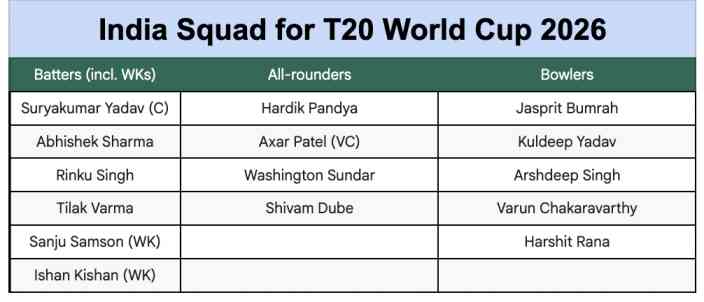
You can see the announced full squads of all teams here.
The squad blends explosive batters, multi skill all rounders, and bowlers suited for different phases of a T20 match. It includes experienced leaders, proven match winners, and players in peak form.
The most notable talking points are the leadership responsibility handed to Suryakumar Yadav, the strong emphasis on spin bowling, and the clear preference for players who thrive under pressure in high tempo games.
Notable omissions include Shubman Gill and Jitesh Sharma — decisions that sparked considerable debate given their pedigree.
Batting Strategy and Structure
Top Order – Powerplay Intent
Abhishek Sharma & Sanju Samson: Paired at the top for explosive intent, Abhishek’s consistent run-scoring and Samson’s ability to take the attack to bowlers set the platform.
Suryakumar Yadav: As captain and the fulcrum of India’s batting, SKY’s ability to rotate strike and accelerate is crucial in the middle overs.
Middle Order – Balance and Control
Rinku Singh & Ishan Kishan: Rinku offers finishing prowess, while Kishan provides explosive backup and depth.
Tilak Varma: A 360-degree batter capable of dominating both spin and pace, offering the perfect blend of control and aggression.
Hardik Pandya: His recent evolution towards aggressive intent “from ball one” adds an X-factor rarely found in all-rounders
Bowling Strategy: Phase Based Control
India’s bowling unit is designed to be multi-phased and tactical:
Powerplay Phase (Overs 1–6)
Arshdeep Singh & Hardik Pandya: Left-arm angle and aggressive seam choices to challenge early.
Jasprit Bumrah: Used judiciously early as a surprise weapon before saving him for crucial overs later.
Middle Overs (7–15)
Kuldeep Yadav & Varun Chakaravarthy: A wrist-spin duo that can choke scoring and take wickets in the middle phase.
Axar Patel & Washington Sundar: Provide control and crucial spin-overs if additional batting depth is needed.
Death Overs (16–20)
Bumrah & Arshdeep: Their execution skills — yorkers, slower balls, and cutters — are essential to restrict runs and take late wickets.
Ideal Playing Combination
The final eleven will depend on conditions, but the preferred setup balances batting depth with bowling variety. It allows India to bat deep, control the middle overs, and defend totals effectively.
While the final XI will depend on pitch and conditions, the ideal combination could look like:
- Abhishek Sharma
- Sanju Samson (WK)
- Suryakumar Yadav (C)
- Tilak Varma
- Hardik Pandya
- Shivam Dube
- Rinku Singh / Axar Patel / Washington Sundar
- Kuldeep Yadav
- Arshdeep Singh
- Varun Chakaravarthy
- Jasprit Bumrah
This XI strikes a balance of power, stability, and bowling variety — crucial in contested T20 clashes.
This flexibility ensures India can adapt without disrupting team balance.
The Winning Formula
1. Defined Gamephases
India’s squad is built for precise phases:
- Explosive Powerplay
- Spin-controlled Middle Overs
- Clinical Death Bowling
This phase-specific approach underpins their winning strategy.
2. Flexibility & Backups
- Multiple wicketkeeping options
- All-round depth
- Explosive finishers
…means India can adjust to match situations and surfaces without compromising balance.
Challenges and Key Talking Points
Fitness Concerns
With Tilak Varma recovering from surgery and uncertain for the early series, India may need to adapt batting combinations — possibly elevating Ishan Kishan or Shreyas Iyer if fit.
Key Decisions
Spin Emphasis: Leveraging wrist spin in subcontinental conditions could be a decisive edge.
Gill’s Exclusion: Signals a shift towards current form and dynamic roles rather than reputation.
Conclusion
ndia’s 2026 T20 World Cup squad reflects modern T20 strategy: specialists at every phase, powerful intent from top to bottom, and tactical depth in both batting and bowling. At a time when the tournament’s stakes couldn’t be higher — and with home advantage in play — this blend of balance, boldness, and flexibility gives Team India a compelling formula to reclaim the crown.