
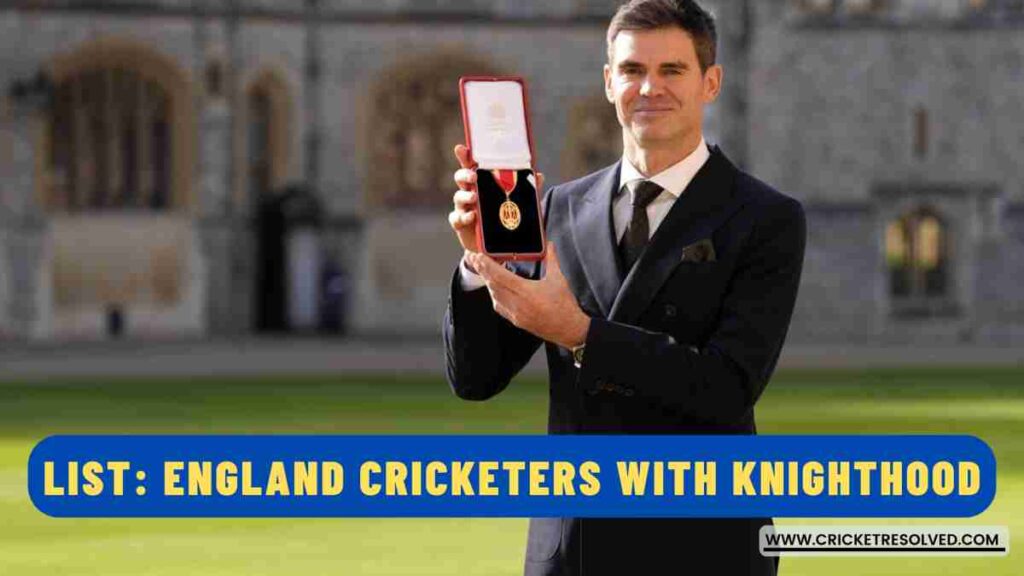
Every country awards their top honours to individuals who make significant contributions in certain fields. The United Kingdom (UK), in particular, awards a knighthood for excellent service to the country.
Cricket is a national summer sport in the UK. So it’s obvious that many renowned English cricketers have been awarded with the country’s top honour – knighthood.
Here’s the complete list of England cricketers who received a knighthood.
1. Francis Lacey | 1926
Francis Lacey was the first English cricketer to receive a knighthood. He was an elegant batter and also chipped in with the ball.
But it was off the field where he made a real impact. Lacey served as secretary of the Marylebone Cricket Club (MCC) for 28 years, from 1898 to 1926.
2. Frederick Toone | 1929
Frederick Toone is a rather unique addition to this list. He never played cricket professionally.
But his excellent administration skills earned him the knighthood in 1929. He received the honour for strengthening the ties between the UK and the Commonwealth territories.
Toone served as the team manager of the MCC on three Australian tours in 1920-21, 1924-25, and 1928-29. He was also the secretary of the Leicestershire County Cricket Club and the Yorkshire County Cricket Club.
3. Pelham Warner | 1937
Pelham Warner served cricket in every possible way. He first excelled as a batter before being a manager, selector and writer.
In a 521-match first-class career, ‘Plum’ aggregated 29028 runs playing for England, Middlesex, and Oxford University. 622 of those runs came for England in 15 Tests.
After his retirement, ‘Plum’ served as the team manager on the 1932-33 Australian tour, infamous for the bodyline tactics. Then he was a selector for a few years.
‘Plum’ wrote a lot about the sport and even founded The Cricketer magazine. Later, he headed MCC as the president.
4. Jack Hobbs | 1953
Jack Hobbs owns one record that perhaps no one will break. He tops the run chart in first-class cricket with 61760 runs, including 199 centuries, for Surrey and England.
Hobbs turned up for England in 61 Tests, scoring 5410 runs at an impressive average of 56.94. Thanks to his impressive consistency, he became the first professional cricketer to receive the knighthood in 1953.
5. Henry Leveson Gower | 1953
Henry Leveson Gower received the knighthood along with Jack Hobbs in 1953. While Gower had a brief stint for England, he scored over 7500 first-class runs for Surrey and Oxford University.
But it was his administrative service that earned him the biggest honour. Gower was a member of the Committee of the MCC and served as the treasurer and president of the Surrey County Club. He was also the chairman of the selection committee.
6. Leonard Hutton | 1956
If Hobbs dominated in the first 30 years, Leonard Hutton made waves in the next 30. So, no wonder he ranks among the greatest cricketers to play for England.
Hutton was a skilful batter and perhaps the best in his era. The right-hander scored 40140 runs in 513 first-class matches for England and Yorkshire. He also spun 173 wickets with his handy leg break.
For England alone, Hutton accumulated 6971 runs in 79 Tests. He even led England from 1952 until his retirement in 1955.
7. Neville Cardus | 1967
Neville Cardus received the knighthood for his contributions to cricket and music, although as a writer.
Interestingly, cricket writing wasn’t even his preferred profession. But Cardus was so good at his craft that his work influenced the future cricket writers.
He wrote several books on cricket and music, including his autobiographies. As a journalist, Cardus worked for The Manchester Guardian (now The Guardian).
Also Read | 5 Memorable Tests Between India and England
8. Gubby Allen | 1986
Gubby Allen juggled as a cricketer and a stockbroker for most of his career. He wasn’t a professional but a decent all-rounder who could bowl fast and contribute runs lower down the order.
In his 265-match first-class career, Allen took 788 wickets and scored 9233 runs, of which 81 scalps and 750 runs came for England. His other numbers came for Middlesex and Cambridge University.
Allen’s real impact, though, was off the field. He served as the chairman of selectors between 1955 and 1961.
Allen also chaired the MCC’s Cricket Committee, playing a major role in penalising illegal bowling. He then became the president and treasurer of the MCC.
9. Colin Cowdrey | 1992
Colin Cowdrey was a sturdy English batter in his era. In a career spanning more than two decades, he amassed 42719 first-class runs, with 7624 of them in England’s jersey in Tests.
At the domestic level, Cowdrey turned up for MCC, Kent, and Oxford University. After his retirement, he served as MCC’s president and ICC’s chairman.
10. Alec Bedser | 1996
Alec Bedser is among the finest English pacers since the Second World War. He troubled batters with his medium pace, mixing up his inswingers and leg cutters well.
In 51 Tests, Bedser minted 236 wickets and scored 714 runs. Although not a complete batter, he aggregated 5735 runs, along with 1924 wickets in 485 first-class matches for Surrey and England.
Later, Bedser became England’s selector before he chaired the selection committee. He even served as a team manager on a couple of tours.
In 1996, Bedser received a knighthood for his excellent service to cricket and became the first English bowler to receive this honour.
11. Ian Botham | 2007
Ian Botham was excellent in cricket and football. So, he had to make a choice between one of them. And he chose cricket, becoming one of the greatest all-rounders of the sport.
Botham found a great balance between batting and bowling. And on many occasions, he won England games with his all-round skills.
In 102 Tests, Botham accumulated 5200 runs and took 383 wickets. In his overall first-class career, he scored 19399 runs and picked up 1172 scalps.
His ODI numbers are decent too, having scored 2113 runs and taken 145 wickets in 116 matches. The List A numbers are even more impressive, with 10474 runs and 612 victims in 470 matches.
12. Alastair Cook | 2019
When Alastair Cook retired in 2018, he had the most runs, centuries, and catches for England in Tests. This shows how good a command he had as a batter and a fielder.
And Cook was equally good as a captain. Under his captaincy, England defeated India in India before Ashes victories in 2013 and 2015.
It was his batting, though, which made him the rock at the top. He scored 12472 runs in 161 Tests, 3204 in 92 ODIs, and 61 in four T20Is.
13. Geoffrey Boycott | 2019
Geoffrey Boycott scored the bulk of his runs while opening for England and Yorkshire. His solid starts often kept his teams away from defeats.
And Boycott’s run-scoring was so valuable that England lost only 20 of his 108 Tests. The defeats came when he failed to put up huge scores.
He had the attacking ability as well, helping him score 8114 runs in his 108-Test career. In first-class cricket, Boycott aggregated 48426 runs in 609 matches, while in List A, he scored 10095 runs in 313 games.
After retirement, Boycott worked as a commentator, known specifically for his controversial and harsh criticism.
14. Andrew Strauss | 2019
Andrew Strauss was an excellent opener for England. Although a few thought he’d make a great career, when the opportunity came, he made the most of it.
Strauss made his Test debut at Lord’s and straightaway smashed his maiden century in 2004. Four years later, he went on to captain England and held the role till his retirement in 2012.
Strauss scored 7037 runs for England in 100 Tests and added 4205 runs in 127 ODIs. His first-class career was remarkable, having scored 17046 runs, most of them for Middlesex.
15. James Anderson | 2025
James Anderson is the newest England cricketer honoured with a knighthood. And it came just a year after his Test retirement.
Anderson bowed out as the finest fast bowler to have played for England, especially in Tests. His 704 wickets in 188 Tests and 269 wickets in 194 ODIs show the efforts he put into his efficient bowling.
Anderson was a master of swing bowling and enjoyed great success in the favourable home conditions for almost 22 years. His determination to represent England for years earned him many accolades.
Read Next | James Anderson’s Incredible Records in International Cricket