
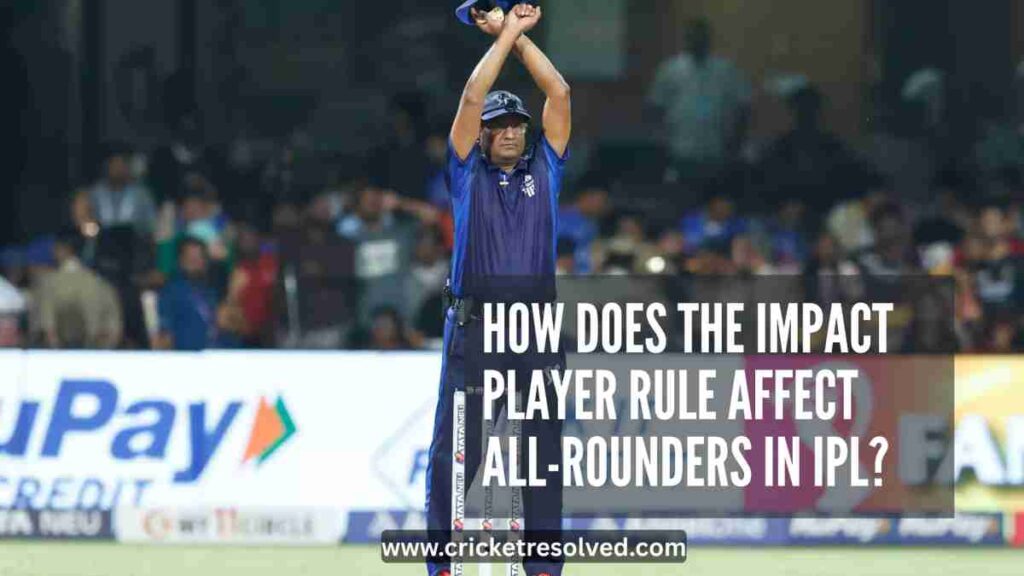
The Indian Premier League (IPL) is known for changing the way T20 cricket is played.
Over the years, the league has introduced many new ideas. Some worked well. Some sparked debates among fans and experts.
And one such rule is the impact player rule.
At first, it looked exciting. Teams could bring in a substitute player during a match depending on the situation. It added more strategy and flexibility.
But as the seasons have passed, many former cricketers have started questioning one thing.
Is the impact player rule hurting all-rounders?
Cricket has always valued players who can bat and bowl. They give balance to a team.
But with the impact player rule, teams can now simply use an extra batter or an extra bowler whenever needed.
And that has changed the role of all-rounders in the IPL.
So let’s understand how the impact player rule affects all-rounders and why many don’t like it.
But first, what is the impact player rule?
So the IPL introduced the impact player rule in 2023.
Under this rule, teams can name five substitute players before the match. During the game, they can bring in a player as an impact player to replace someone in the playing XI.
For instance, a team batting first can play an extra batter. And then while bowling, they can substitute that batter with a specialist bowler.
This gives teams more flexibility depending on the match situation. And honestly, it sounds smart.
But there’s one problem.
It reduces the need for genuine all-rounders.
Why were all-rounders so valuable earlier?
Before the impact player rule, teams had to carefully balance their XI.
So they usually played five batters, one wicketkeeper and three to four bowlers.
And since all-rounders provided balance, teams stocked up on two or three all-rounders.
Imagine a player who could score quick runs and also bowl a few overs. Even if they may not be world-class in one skill, their two-way contribution would matter a lot.
That’s why players like Hardik Pandya, Ravindra Jadeja, Andre Russell and Shane Watson became such big match-winners in the IPL.
They allowed teams to play an extra batter or bowler without weakening the lineup.
But now things are different.
How does the impact player rule change things?
Now teams no longer need one player to do two jobs.
Instead, they can simply use a specialist batter while batting and a specialist bowler while bowling. As simple as that. And because of that, teams are relying less on all-rounders.
This means the balance that all-rounders used to provide is no longer as important as before.
Fewer Bowling Responsibilities for Batters
One major concern is that young batting all-rounders are bowling less.
Since teams already have extra bowling options through substitutions, captains don’t feel the need to use part-time bowlers often.
As a result, batters are focusing mostly on batting, bowlers are focusing only on bowling and the true all-round development is going downhill.
And that could become a problem for Indian cricket in the future. Because international cricket still values genuine all-rounders a lot.
Indian Cricket Could Feel the Impact
Many former cricketers believe the impact player rule may hurt India in the long run.
Why?
See, the IPL plays a huge role in developing Indian talent.
Young players learn pressure handling, game awareness and different skills through the tournament.
But if franchises stop encouraging players to contribute in multiple departments, fewer complete cricketers may emerge.
And finding quality fast-bowling all-rounders is already difficult in Indian cricket.
That’s why many have spoken about the importance of maintaining balance in T20 cricket.
Final Thoughts
The impact player rule has completely changed how teams strategise in the IPL.
It has made matches more flexible and aggressive. But at the same time, it has reduced the importance of traditional all-rounders.
Earlier, teams desperately searched for players who could bat and bowl. Now, they can simply substitute specialists depending on the situation.
And because of that, the role of many all-rounders has become smaller than before.
The rule may continue to entertain fans. But whether it helps Indian cricket in the long run is still a big question.
Read Next | How Player Trade Works in the IPL?