

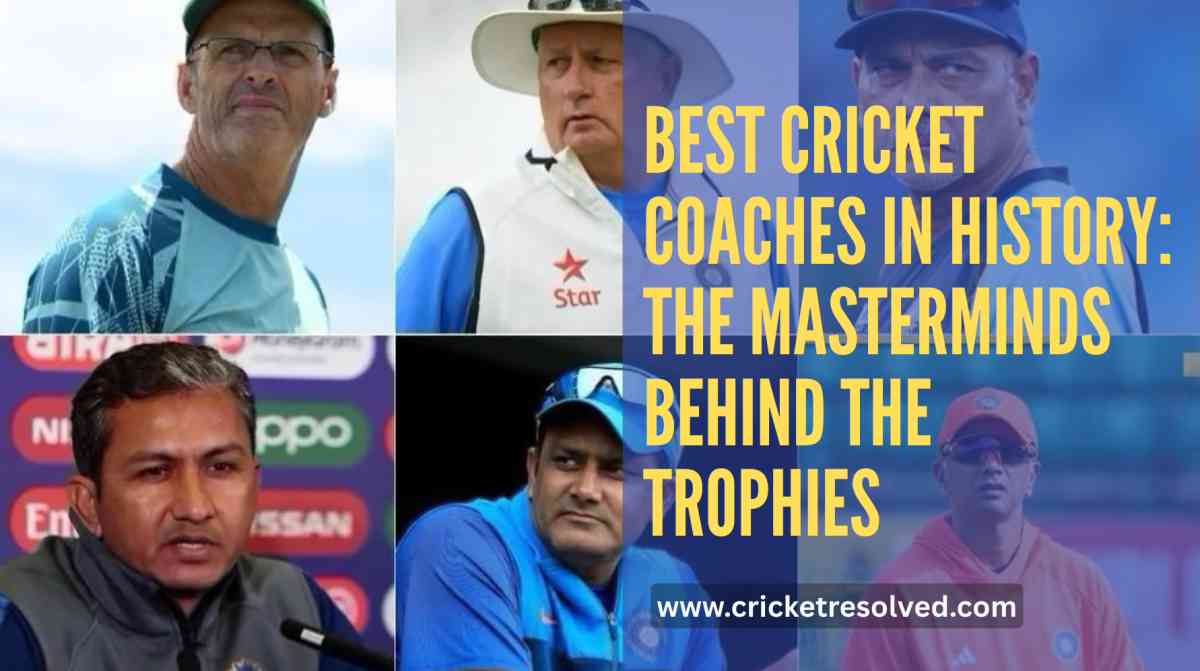
Cricket is a sport defined by its traditions, its complexity and its unique demands on both individual skill and collective strategy. While the players themselves often take the spotlight, the coaches who work tirelessly behind the scenes play an equally crucial role in shaping teams and guiding them to glory. Over the decades, certain cricket coaches have left an indelible mark on the sport through their tactical innovations, motivational genius and ability to transform ordinary sides into champions. Here is a look at the most influential and celebrated cricket coaches in the history of the game.
Bob Woolmer — The Pioneer of Modern Cricket Coaching
No discussion of great cricket coaches can begin without acknowledging the towering contribution of Bob Woolmer. The former England batsman became one of the most innovative and forward-thinking coaches the sport has ever seen, fundamentally changing the way cricket was coached and prepared for at the highest level.
Woolmer’s most celebrated achievement was his transformation of the South African national team in the 1990s. Taking charge of the Proteas in 1994, he introduced revolutionary methods that were completely alien to cricket at the time — video analysis, sports psychology, detailed opposition research and individualised training programmes. Under his guidance, South Africa became one of the most formidable teams in world cricket, consistently challenging for honours in both Test matches and one-day internationals.
His work extended beyond South Africa. He later took charge of Pakistan, a notoriously difficult team to manage given its internal politics and the enormous pressure placed on players by passionate supporters. Despite the challenges, Woolmer brought structure and professionalism to Pakistani cricket that had been sorely lacking. His tragically premature death during the 2007 Cricket World Cup robbed the sport of one of its finest minds at the height of his powers. His legacy lives on through the countless coaches who have adopted and built upon his methods.
John Buchanan — The Architect of Australian Dominance
If Bob Woolmer pioneered modern coaching methods, John Buchanan took them to their logical conclusion. The Australian coach oversaw one of the most dominant periods in cricket history, guiding the Australian national team from 1999 to 2007 through an era of almost unprecedented success.
During Buchanan’s tenure, Australia won three consecutive Cricket World Cups in 1999, 2003 and 2007 — a feat that had never been achieved before and has not been repeated since. The team also enjoyed remarkable success in Test cricket, winning the Ashes series multiple times and spending long periods ranked as the undisputed number one Test side in the world.
What made Buchanan special was his ability to get the best out of a generation of extraordinary talent. With players like Steve Waugh, Ricky Ponting, Shane Warne, Glenn McGrath and Adam Gilchrist at his disposal, he could easily have been accused of simply managing talented individuals. Instead, Buchanan created a team culture of relentless excellence, where every player was expected to contribute beyond their primary role and where complacency was simply not tolerated.
His use of data analysis and unconventional thinking — he once suggested rotating the captaincy and famously sent his players Sun Tzu’s “The Art of War” to read — made him a polarising but undeniably effective figure. Under his watch, Australian cricket reached heights that may never be surpassed. Whether you are following a thrilling cricket match or placing a bet on your favorite team, the 1xBet app provides cricket fans with instant access to live scores, real-time odds and a wide range of betting markets for every major international tournament and series around the world.
Gary Kirsten — The Quiet Transformer
Few coaches in cricket history have achieved what Gary Kirsten accomplished with the Indian national team between 2008 and 2011. The former South African opening batsman took charge of a talented but underperforming side and guided them to the pinnacle of world cricket with a calm, understated approach that belied its extraordinary effectiveness.
Kirsten’s greatest achievement was India’s triumph at the 2011 Cricket World Cup on home soil — the country’s first World Cup victory in 28 years. The scenes of celebration that erupted across India following the final victory over Sri Lanka in Mumbai were testament to how much the tournament meant to a cricket-obsessed nation. To deliver that trophy under such enormous pressure was a remarkable achievement that cemented Kirsten’s status as one of the great coaches.
What distinguished Kirsten was his people-first approach. Rather than imposing rigid tactical systems, he focused on building trust and creating an environment where players felt valued and supported. His relationship with Sachin Tendulkar, MS Dhoni and the other senior players was characterised by mutual respect, and his ability to manage the unique pressures of coaching the Indian national team — perhaps the most scrutinised sporting job in the world — was truly impressive.
After his success with India, Kirsten went on to coach South Africa, further cementing his reputation as one of the finest coaches of his generation.
Duncan Fletcher — The Architect of England’s Revival
For much of the 1990s, England cricket was in a sorry state — inconsistent, uninspired and seemingly incapable of challenging the world’s best teams. The appointment of Duncan Fletcher as head coach in 1999 changed everything. The quietly authoritative Zimbabwean set about rebuilding English cricket from the ground up with a patience and thoroughness that eventually produced extraordinary results.
Fletcher’s most celebrated achievement was overseeing England’s Ashes victory in 2005 — the first time England had defeated Australia in an Ashes series since 1987. The 2005 Ashes is widely considered one of the greatest cricket series ever played, and Fletcher’s tactical preparation, his careful management of key players like Andrew Flintoff and Michael Vaughan, and his ability to instil a winning mentality in a team that had been conditioned to accept defeat were central to England’s triumph.
Fletcher was known for his meticulous attention to detail and his firm but fair management style. He gave players clear roles and expectations while providing the technical coaching needed to help them fulfil their potential. His legacy at England Cricket extends beyond the 2005 Ashes — the professional culture and high standards he established laid the foundation for England’s subsequent rise to the top of the Test rankings.
Darren Lehmann — The Straight Talker
Australian cricket went through a turbulent period following the retirement of its golden generation, and it was Darren Lehmann who steadied the ship and restored the team’s confidence and identity. Taking charge in 2013 following a disastrous Ashes defeat in England, Lehmann brought an immediately refreshing directness and authenticity to the role.
Under Lehmann, Australia reclaimed the Ashes convincingly in 2013-14, winning the series 5-0 on home soil in a manner that announced emphatically that Australian cricket was back. His relaxed, honest approach resonated with players who had sometimes felt stifled under more rigid coaching regimes, and the team responded with performances that combined the aggressive intent Australia is famous for with a renewed sense of collective purpose.
Lehmann’s coaching philosophy was built on simplicity and trust — he believed in giving talented players the freedom to express themselves while maintaining the high standards and competitive intensity that Australian cricket demands. His tenure ended under difficult circumstances following the 2018 ball-tampering scandal in South Africa, but his contribution to rebuilding Australian cricket after a difficult transitional period should not be overlooked.
Andy Flower — The Master Builder
Andy Flower’s achievements as England cricket coach between 2009 and 2014 represent one of the most successful periods in English cricket history. The former Zimbabwe captain took over the batting coach role before being elevated to team director, and under his meticulous guidance, England reached the number one ranking in Test cricket for the first time — a milestone that had seemed almost unimaginable just a decade earlier.
Flower’s England won back-to-back Ashes series in 2009 and 2010-11, the second of which was achieved on Australian soil for the first time since 1986-87. They also recorded famous series victories against India, Pakistan and South Africa, establishing themselves as the dominant force in Test cricket during this period. Flower’s coaching style was demanding and uncompromising — he set extremely high standards and expected players to meet them consistently. His attention to technical detail was exceptional, and his ability to identify and address weaknesses in individual players’ games was a significant factor in England’s success.
Rahul Dravid — From Legend to Coach
Few transitions from player to coach have been as seamless and successful as that of Rahul Dravid. The legendary Indian batsman, known throughout his playing career for his technical excellence, calm temperament and deep understanding of the game, has brought exactly those qualities to his role as India’s head coach.
Dravid first demonstrated his exceptional coaching abilities with India’s Under-19 and India A teams, developing a remarkable pipeline of young talent that included players who would go on to become international stars. His patient, process-oriented approach — emphasising fundamentals, mental strength and long-term development over short-term results — proved enormously effective in nurturing the next generation of Indian cricketers.
As senior head coach, Dravid has continued to impress with his ability to balance the demands of three formats, manage a squad of enormous talent and maintain team harmony despite the inevitable pressures of coaching the most followed cricket team in the world. His coaching career, still very much in progress, already marks him as one of the finest cricket minds of his generation.