
The Men’s T20 World Cup 2026 has been off to a flyer. The opening week delivered some close finishes.
Take, for instance, the England versus Nepal game, which went down to the wire. England were not certain of a win till the last ball. And many would’ve perhaps thought of a possible tied match.
While England walked off with a four-run win, what if the game had ended in a tie? What scenarios would’ve played out?
Well, here’s our explainer!
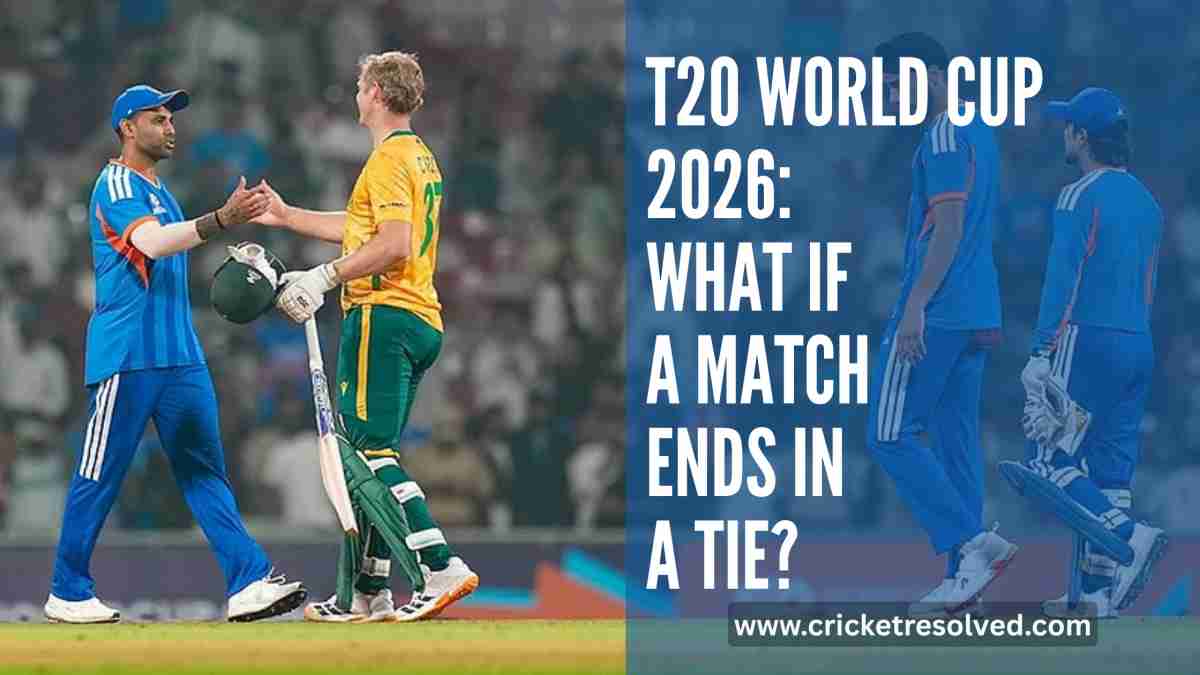
What if a match ends in a tie in the T20 World Cup 2026?
In case a match ends in a tie, we would see a Super Over. And this applies to all matches, including the semi-finals and the final, in the T20 World Cup 2026.
How does the Super Over work?
The Super Over acts as a tie-breaker. It helps determine the winner of the match.
Both teams shall get to bat one over of six balls. The Super Over shall start five minutes after the match ends.
The team that batted second in the match shall bat first in the Super Over. They can nominate three batters who would bat in the tie-breaker.
The bowling team, on the other hand, can nominate a bowler. The captain of the bowling side can also pick the ball they want to use for the Super Over.
Once the Super Over starts, the batting side should look to score as many runs as possible. If they lose two wickets, that would be the end of their Super Over. Then the other side shall look to chase down the target.
The team with the most runs shall win the Super Over and, obviously, the match with two points.
Know All About T20WC 2026 Here
ICC T20 World Cup 2026: Schedule & Other Details
How does the Group Stage Work in T20 World Cup 2026?
T20 World Cup 2026: How does the Super 8 stage work?
T20 World Cup 2026: Broadcast & Live Stream Details
India’s T20 World Cup 2026 Schedule
Explained: 2026 Men’s T20 World Cup Qualification Pathway
T20 World Cup 2026 Qualified Teams
T20 World Cup 2026: How Scotland replaced Bangladesh?
T20 World Cup 2026: What happens if it rains?
T20 World Cup 2026: What if a match ends in a tie?
What if the Super Over also ends in a tie?
Then we would have another Super Over. And we would have subsequent Super Overs till a result is determined. The subsequent Super Overs need to take place within the allocated time, though.
Is the procedure for the subsequent Super Overs the same?
Most of the procedure is similar to the initial Super Over. But the batters and bowlers may change.
For instance, a batter dismissed in the initial Super Over can’t bat in the subsequent one. However, if a batter was not out, retired hurt, or didn’t bat, they can bat again. The bowling side, on the other hand, would nominate a new bowler.
What if the Super Over can’t be finished?
In case bad weather or some exceptional conditions don’t allow the completion of the Super Overs, the match shall then end in a tie. And both teams should share one point each.
Read Next | T20 World Cup 2026: What happens if it rains?