
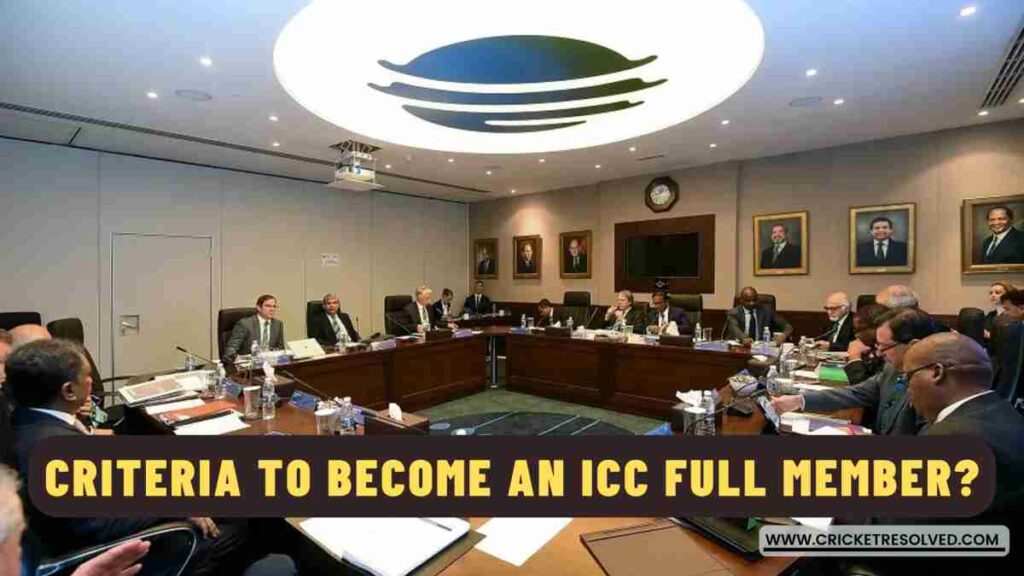
If you’ve been watching cricket for some time now, you must’ve come across this term – ICC full member. For instance, India or the BCCI have ICC’s full membership.
And as of now, 12 national boards are ICC’s full members with Test status. But cricket isn’t limited to only these countries.
The sport has reached far-flung territories. Even the Cook Islands, with a population of around 15,000, have a cricket structure in place.
The ICC gives an associate membership to such small countries. They can mostly play T20I cricket, with a few allowed in the ODI setup.
But being an associate member has its own limitations, like the fund crunch, exposure, and a lot of other issues. And to overcome this, they aim to become a full member.
But it’s not as simple as it may seem. The associates must fulfil some criteria on their way to becoming an ICC full member.
Here’s a breakdown of the requirements an associate needs to meet to become an ICC full member.
General
The most basic step is the associate board must be recognised by the ICC. And the board must look after the administration and development of cricket in its respective country.
This involves both men’s and women’s cricket structures. Plus, the board must be solely responsible for the men’s and women’s cricket in its country.
Most associates perhaps meet this criterion. But they need to fulfil a lot more requirements. And here comes the most important one.
Governance
If an associate doesn’t have a governance system in order, then they should forget about the full membership. The ICC might even suspend its associate membership. Take, for example, the USA Cricket Association’s suspension and expulsion in 2017 due to non-governance.
So, a governance system is a must. And the system should include a detailed written constitution, which is the top priority.
The constitution must have provisions for voting rights and annual general meetings (AGM). It should also cover rules about anti-corruption, anti-doping, and ethics.
Administration
Once the governance system is sorted, the board must have an executive, administrative, and corporate structure in place. This should allow the board to perform its duties as mentioned in the constitution.
Finance
And now comes the financial aspect. The finances of the associate board are pretty important.
The board must produce at least 10 per cent of its total revenue on its own (excluding ICC funding) in each of the last four years. On top of that, the board shouldn’t be in major debt in each of the last four years. And they need to submit a complete audit of their financial accounts for the last four years.
Once the off-field criteria are met, the focus shifts to the on-field performance and development.
Performance
The ICC has set some basic performance requirements that associate members must meet. The first and foremost is the associate members must feature on the men’s ODI team rankings.
Then comes their performance in the ICC’s white-ball World Cups. The associate board must’ve featured in three men’s ODI World Cups or men’s T20 World Cups in the last eight years. But only participation isn’t enough.
They need to defeat a full member team in any of the two tournaments. Even a win in the ODI World Cup Qualifier will do. The win, though, should come against a full member team that is in the top 10 in ODI or T20I team rankings.
Apparently, the wins in these multi-national competitions aren’t enough either. They also need to have a credible track record in bilateral series.
The associate board must have four victories against two or more full members in bilateral men’s series. The bilateral wins must come in ODI or T20I series in the last eight years. And given how little bilaterals associates play against full members, it’s almost dreamlike to fulfil this criterion.
The associates can’t overlook the youth participation either. The men’s under-19 team of the associates must’ve played in two Under-19 World Cups in the last eight years.
Now that was all about the men’s team. The women’s teams of associates also need to meet some requirements.
The board must’ve featured in one women’s ODI World Cup or women’s T20 World Cup in the last four years. And they must be ranked on the women’s ODI rankings.
Participation and Domestic Structure
While the associate nations’ performance on the international stage is important, they shouldn’t overlook their domestic setup.
The board must organise men’s 50-over and 20-over tournaments at the national level with a minimum of three teams. And the tournaments must’ve List A and List A T20 status, respectively. There should also be pathway tournaments for the men’s junior and women’s cricket.
On top of that, the associate must have an adequate pool of players to select for the national squads across all categories. And then the most important thing: there should be strong participation at the domestic level and signs of growth in the last eight years.
Infrastructure
The associate board needs to tick basic infrastructure-related criteria as well. They should have access to a minimum of two ODI venues with the ICC’s accreditation.
Development Programme
The board must’ve run an awareness programme to promote cricket across all ages in the last four years. And they should’ve organised development programmes for coaches, umpires, pitch curators, and scorers in the same period.
Final Approval
Once an associate board meets all the requirements, it needs to apply to become a full member. Then ICC’s membership committee inspects the criteria fulfilled by the board before it passes on a recommendation to the board of directors.
The ICC then brings up a special resolution in its AGM about granting full member status to the concerned associate board. The resolution needs approval from existing full members. Once the approval comes, the associate board will become a full member.
Read Next | Difference between First-Class Cricket & List-A Cricket