
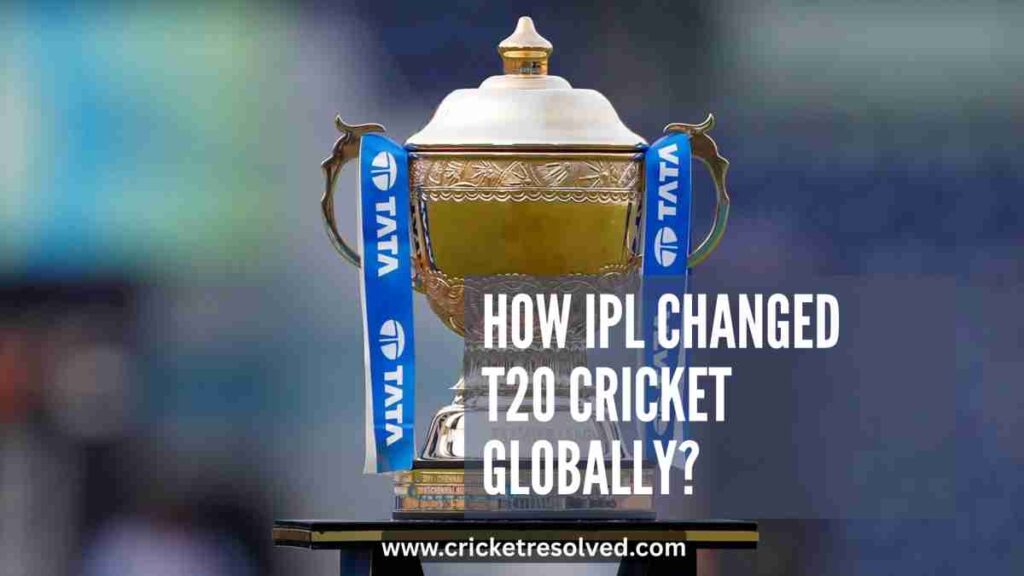
Think about T20 cricket before 2008. It existed, sure. But it was nothing like what you see today.
And the major credits go to the Indian Premier League (IPL). The league rewrote the entire rulebook of how T20 cricket is played, watched and valued around the world. Everything from batting tactics to broadcasting deals took a dramatic turn.
On that note, here’s a look at how the IPL changed T20 cricket.
T20 Turned Into a Global Business
Before the IPL, cricket was still largely a gentleman’s game tied to tradition.
The BCCI launched the IPL in 2008. And within a few seasons, it became one of the most valuable sports leagues in the world.
Franchise valuations, broadcast rights and sponsorship deals exploded to levels no one had imagined. The IPL proved that T20 cricket was more than entertainment. It was, in fact, a goldmine.
Sparked a League Revolution Worldwide
Once the IPL became a hit, every cricket board wanted a piece of it.
So new T20 leagues started cropping up across the world. The Big Bash League, Caribbean Premier League, Pakistan Super League, SA20, The Hundred, ILT20, all came one after another.
These leagues didn’t come out of nowhere. They were directly inspired by what the IPL built.
Nations that once struggled to fill stadiums now had packed grounds, prime-time broadcast slots and serious investor interest. The IPL essentially handed every cricket board a money-making blueprint.
Redefined How Batters Play the Game
Remember when playing through the line was considered risky? When hitting up in the sky wasn’t encouraged?
The IPL killed that thinking completely.
Batters started practising ramps, scoops, switch hits and reverse sweeps. Scoring 200 in 20 overs went from being extraordinary to being almost expected.
Young batters around the world grew up watching IPL innings and trained specifically to replicate that fearless, aggressive brand of cricket.
Bowlers Became More Creative Under Pressure
Bowling in the IPL is brutal. You’re up against the best hitters in the world, with nowhere to hide.
That pressure forced bowlers to evolve rapidly. They added more variations.
The slower ball. The knuckle ball. The wide yorker. The back-of-the-hand delivery. These became essential weapons, not optional variations. Bowlers who couldn’t adapt simply got hit out of the attack.
Flexibility for Cricketers
Before the IPL, a cricketer’s value was almost entirely tied to their international career.
The IPL changed that equation.
A player from the West Indies or Afghanistan could suddenly earn life-changing money by performing in one IPL season.
Rashid Khan, Sunil Narine and Jofra Archer are prime examples of players whose global profiles exploded through the IPL before or beyond their international careers.
Cricket now had a parallel economy. And players everywhere started taking T20 cricket seriously as a profession in itself.
Also Read | Navigating Cricketing Careers: Franchise Contracts vs. National Board Commitments
Accelerated the Development of Smaller Nations
Here’s something that doesn’t get talked about enough.
The IPL pushed up the quality of T20 cricket at every level. As franchise leagues multiplied globally, inspired by the IPL model, players from Afghanistan, Ireland, Nepal and the UAE finally had competitive platforms to grow.
Afghanistan’s rapid rise in world cricket is closely linked to their players getting IPL exposure and league experience. That trickle-down effect has been enormous for the game’s global health.
Changed the Way Cricket is Coached
Before the IPL, coaching structures in cricket were fairly traditional.
The IPL brought in a mix of international coaches, analysts and support staff under one roof like never before. Data analytics, ball-tracking, wagon wheels and match-up statistics became everyday tools in the dugout.
That professionalism filtered into domestic setups across the world. Countries started investing in coaching infrastructure because the IPL showed what a well-run franchise operation could look like.
Shifted the Centre of Power in World Cricket
This is the big one. And everyone knows it.
Before the IPL, cricket’s power balance was more evenly spread across major nations. After the IPL, the BCCI’s financial dominance became undeniable.
Broadcast revenue, player contracts and scheduling decisions increasingly revolved around the IPL window.
That shift has been controversial at times. But it’s a reality that every cricket board now has to work around.
Made T20 Cricket Cool for a New Generation
Perhaps the most underrated impact of the IPL is cultural.
It brought in Bollywood, celebrity ownership and prime-time entertainment. Cricket stopped being just a sport and became a spectacle.
A generation of fans across the world fell in love with cricket through the IPL first. They then followed the game deeper, into Test matches, bilateral series and World Cups.
The IPL served as the entry point into cricket for millions.
Conclusion
In the end, the IPL’s influence on global T20 cricket isn’t one big moment. It’s a thousand small revolutions that happened simultaneously.
It changed how the game is played, how it is valued and who gets to play it on the biggest stage.
Whether you love the IPL or have complicated feelings about it, one thing is impossible to deny. T20 cricket before 2008 and after 2008 are two completely different sports. And the IPL is the reason why.
Read Next | The Origin Story of the Ashes – Cricket’s Oldest Rivalry